When the Factory Sets the Schedule
Sourcing Data to Physical Constraints · Part 2
On AI-infrastructure projects, securing a production slot for critical electrical equipment is only half the job. The other half is moving that equipment from the factory floor to energization, through testing, transport, storage, rigging, and commissioning, without losing the schedule the slot was meant to protect.
Most construction schedules carry an unspoken assumption: the equipment will show up when the site needs it. Procurement places the order, the supplier confirms a date, and the schedule moves on.
On AI data-center projects, that assumption has been turned around. Large power transformers are being quoted at 100 to 150+ weeks, 38 kV switchgear at 78 to 104 weeks, and large diesel generators at 90 to 110 weeks. One contractor's 2026 guidance is blunt: if you are not ordering electrical equipment 12 to 18 months before you mobilize the site, you are already behind.
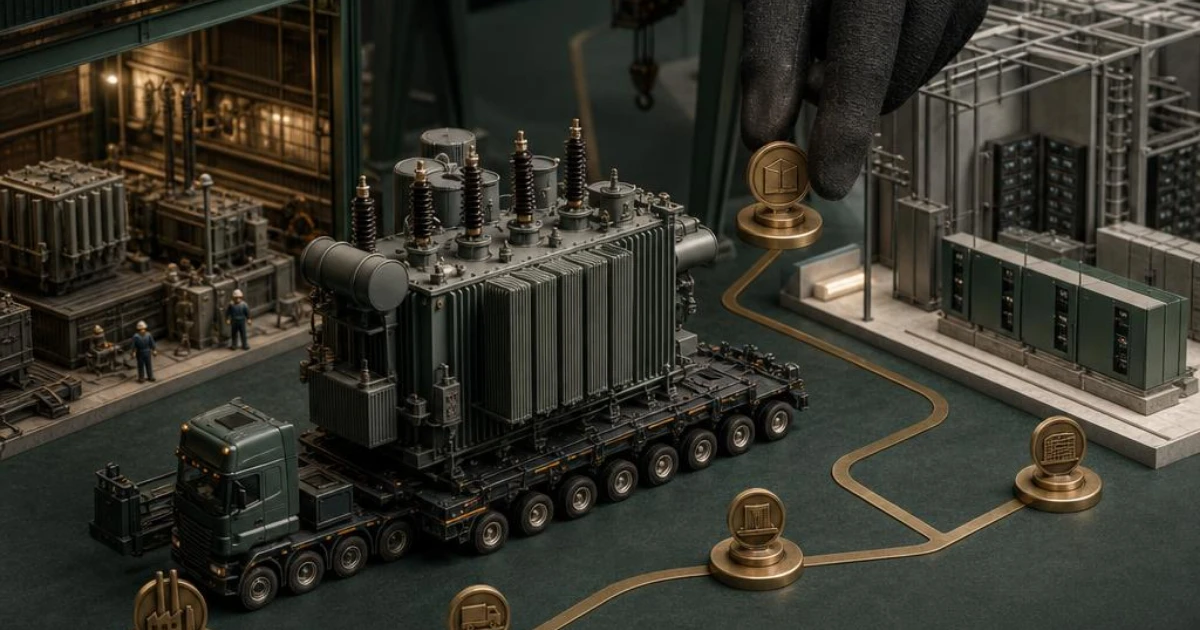
When equipment lead times run longer than the construction itself, the factory's production calendar becomes the project's master schedule. Everything downstream (site readiness, trade labor, commissioning, and the revenue date) depends on a chain of handoffs between a factory and a jobsite that may be hundreds or thousands of miles apart.
That chain is a logistics problem, and it is often managed as an afterthought.
The five handoffs between factory and energization
Every critical item passes through the same sequence. Each step has its own owner, its own lead time, and its own way of failing.
- Factory acceptance testing Large electrical equipment typically ships only after testing at the factory, often witnessed by the owner or engineer. A missed witness date or a failed test can push the ship date by weeks, and that change often does not reach the jobsite schedule in time.
- Transport Transformers, switchgear lineups, generators, and large chillers are often oversize or overweight loads. Moving them can require route surveys, state-by-state permits, escorts, and specialized trailers, and sometimes rail or barge segments. Seasonal restrictions, bridge limits, and carrier availability all affect delivery windows. A slot secured two years ago does not guarantee a truck, a permit, or a route in the week the equipment is ready.
- Receiving and storage Early delivery is not automatically good news. Equipment that arrives before the building or pad is ready has to be stored, sometimes in climate-controlled conditions. Batteries need ongoing maintenance, and stored gear may need to be re-inspected before it can be installed. Someone has to own that cost and that risk, and the contract should say who.
- Rigging and setting Placing heavy equipment requires cranes, rigging crews, clear access paths, and a pad or room that is actually complete. On a congested campus with multiple trades and phases, a setting window can be lost to a concrete pour, a crane conflict, or an incomplete access road.
- Testing and energization Once set, the equipment still has to be terminated, tested, and integrated into the facility's systems before the hall can be energized. Damage in transit, missing components, or documentation gaps found at this stage are often the hardest to recover from, because little schedule float is left to absorb them.
When any one of these handoffs slips, the result looks the same from the outside: a finished building waiting on power.
Early can be as costly as late
The usual instinct in a constrained market is to pull everything forward. Order earlier, ship earlier, store on site. That reduces one risk and creates others.
Early arrivals consume laydown space on sites that are already crowded. They tie up cash in deposits and inventory before revenue starts. They create storage, insurance, maintenance, and re-inspection work that may not be priced into anyone's contract. And they can create a false sense of security: the equipment is on site, but the room it goes into is not ready.
The goal is not the earliest possible delivery. It is synchronized delivery, where each piece of equipment arrives when its pad, its crew, and its downstream testing are ready for it.
Plan backward from the factory, not forward from the site
In logistics, the discipline is to plan backward from the required delivery date. In this market, the starting point has moved. The plan has to begin at the factory's production calendar and work forward to energization, and then backward again to check that the site can keep pace.
For each critical item, that means maintaining one line of sight across:
- Production slot and test date
- Confirmed with the manufacturer and updated as it moves
- Ship window and route
- Including permits, carrier, and any rail or barge segments
- Site-ready date
- Pad, room, access path, and crane availability
- Storage plan
- If timing does not align, with cost and maintenance responsibility assigned
- Setting, termination, and testing windows
- Tied to the milestone that triggers revenue or penalties
- A named owner for each handoff
- Across owner, contractor, supplier, and carrier
This does not require new technology. It requires one register that connects the procurement view (what was ordered and when it will ship) to the construction view (when the site can receive and install it), and someone accountable for keeping the two aligned.
The factory sets the schedule, but logistics determines whether the schedule holds.
Who carries this risk
- Owners and developers
- carry the revenue date. A late energization delays the return on the whole investment, not just one system.
- General contractors and MEP contractors
- carry the jobsite. Even when the owner buys the equipment directly, the contractor typically receives, stores, sets, and connects it, and is increasingly exposed to penalties tied to energization and handover milestones.
- Equipment suppliers
- carry the ship date and, increasingly, the reputation for delivering on it. Their own logistics and testing capacity are now part of what they are selling.
- Investors
- should ask whether a company's delivery schedule is backed by a credible plan from factory to site, not only by a confirmed order.
Five questions for project and operations leaders
- For each critical item, do we know the factory test date as well as the ship date?
- Have transport routes, permits, and carriers been confirmed for our oversize loads?
- If equipment arrives early, who owns storage, maintenance, and re-inspection, and is that cost priced?
- Is each setting window tied to a confirmed site-ready date?
- If your critical equipment shipped on time tomorrow, is your site ready to receive it?
Our view
On AI-infrastructure projects, the factory sets the schedule, but logistics determines whether the schedule holds. The organizations that energize on time will be those that treat the path from factory to energization as a managed sequence of handoffs, with one register, clear ownership, and delivery timed to site readiness.
Vantage Pointe Partners brings operator-led logistics and sourcing discipline to that sequence: sequencing critical equipment, planning heavy-haul and staging logistics, and tying delivery to the milestones that drive revenue.
Related reading
Discuss this topic
Talk with Tim about mapping the path from factory to energization for your critical equipment.
Discuss this topicVANTAGE POINTE PARTNERS — OPERATOR-LED ADVISORY